“If you love the look of the classic 'Sky Pencil' holly, you're going to want to meet Red Sky — an upright, narrow Japanese holly with a twist. The new leaves come in this gorgeous purplish-red before…”
Pieris purpurea
Red Sky Holly Has Some Advantages Over Sky Pencil Holly
If you love the look of the classic 'Sky Pencil' holly, you're going to want to meet Red Sky — an upright, narrow Japanese holly with a twist. The new leaves come in this gorgeous purplish-red before maturing to deep green. Plus, it has a slightly curved silhouette, unlike 'Sky Pencil's' stick-straight stems, which makes it way less likely to splay open as it grows. It also fills in faster and fights off the spider mites and root rot that have been giving 'Sky Pencil' trouble down South.
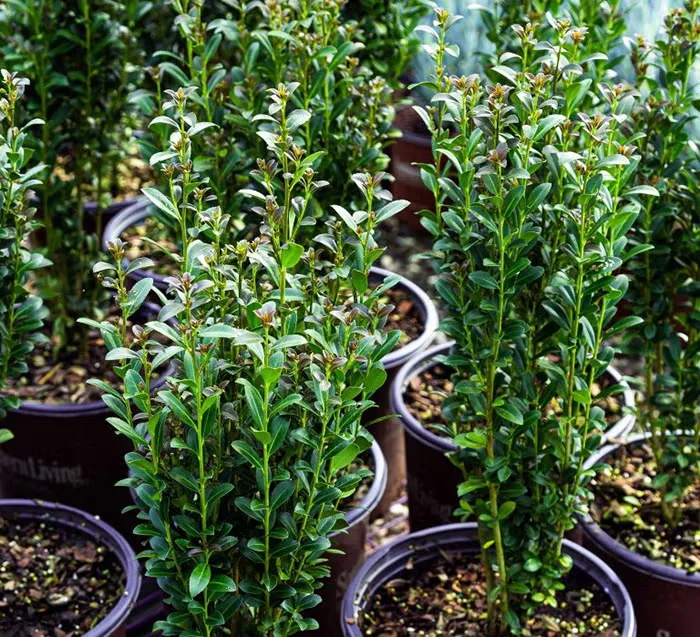
Commonly called: Red Sky Japanese holly
Botanical name: Ilex crenata 'RutHol8'
Exposure: Full sun to part shade — it's not too picky
Both are pretty inconspicuous, honestly. Unlike those flashy red-berried hollies, this one is all about the foliage and form.
The evergreen leaves are roughly fingernail-sized — cute and small! New growth pops out purple-red and then deepens to a rich forest green.
This one grows in a nice columnar shape, eventually reaching about eight feet tall and three feet wide — tall and slim.
The species Ilex crenata hails from northern Asia and eastern Russia, where it's typically found as a big, rounded shrub in woodlands and on mountain slopes. Red Sky ('RutHol8') was developed at the University of Georgia and hit the gardening market in 2024 under the Southern Living Plant Collection brand.
Like other Japanese hollies, Red Sky is happy in full sun to part shade with well-drained soil of average fertility. It does best in neutral to acidic conditions — alkaline soil can make the leaves turn yellow, which nobody wants. Make sure it gets regular, deep watering while it's settling in, especially as winter approaches. Once established, it can handle short dry spells, but it really stays happiest with consistent moisture. Hardy in USDA Zones 6–9.
Image courtesy of Southern Living Plant Collection