“Pearls of Perfume is a hybrid mock orange (Philadelphus) that just keeps blooming from spring right through fall, with double white flowers that smell wonderfully citrusy. This fragrant beauty works…”
Allium japonica
Pearls of Perfume Mock Orange Offers Lengthy and Fragrant Bloom
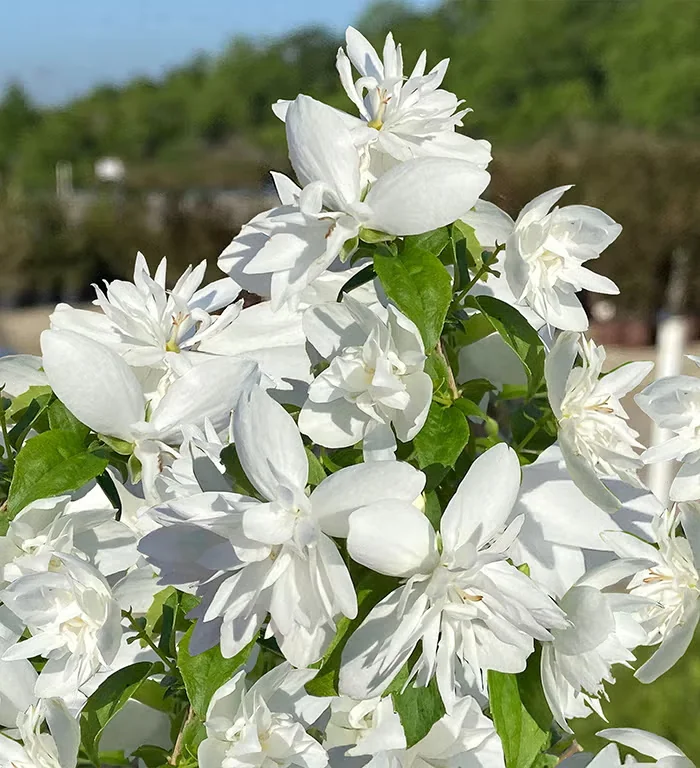
Pearls of Perfume is a hybrid mock orange (Philadelphus) that just keeps blooming from spring right through fall, with double white flowers that smell wonderfully citrusy. This fragrant beauty works beautifully in a mixed border or a big container, or you can plant several as a gorgeous flowering hedge. Fun fact — Pearls of Perfume even made the shortlist for Plant of the Year at the 2023 Chelsea Flower Show.
Common name: Pearls of Perfume mock orange
Botanical name: Philadelphus 'G15097'
Type of plant: Reblooming deciduous shrub
Exposure: Full sun to part shade
Flowers: Large (three-inch-wide), sterile, fragrant, pure white flowers with double the usual number of petals rebloom from spring to fall. Since this mock orange blooms on both old and new wood, you get an extra-long flowering season.
Foliage: Deciduous, deep green, and oval-shaped. Nothing to write home about in fall color.
Size and habit: This mock orange grows four to five feet tall and three to four feet wide, with upright stems creating a vase shape. The dense branching and quick growth are a big part of why it flowers so heavily.
Origins: Part of the Southern Living Plant Collection and Sunset Plant Collection, Pearls of Perfume was introduced in 2022. It was bred in Pennsylvania by Rick Grazzini at GardenGenetics — a cross between Philadelphus lewisii 'Snow Velvet' and an unnamed Philadelphus xvirginalis. Philadelphus lewisii is a fragrant shrub native to the northwestern U.S. and nearby Canadian provinces, where it grows on rocky slopes and in open woods (it's actually the state flower of Idaho!). Philadelphus xvirginalis is itself a hybrid that usually has semi-double or double flowers.
How to grow it: Plant Pearls of Perfume mock orange in a well-draining spot with moderate watering in full sun to part shade. It likes soil rich in organic matter but will tolerate poorer soil just fine. Flowers come from both last year's growth and new growth, which is why it blooms for so long. The compact size means you probably won't need to prune, but you can give it a trim after that first big flush of spring blooms if you want to shape it up. USDA Zones 5–8.
Image courtesy of Southern Living Plants Collection