“You'll want to grow 'Blue Ball' Korean pine (Pinus koraiensis 'Blue Ball') for those stunning blue-green needles that trace its loosely globe-shaped form. This is a dwarf conifer with a slow growth…”
Callicarpa purpurea
This Dwarf Conifer Has Soft and Beautiful Blue Needles
You'll want to grow 'Blue Ball' Korean pine (Pinus koraiensis 'Blue Ball') for those stunning blue-green needles that trace its loosely globe-shaped form. This is a dwarf conifer with a slow growth rate and a couldn't-be-easier personality — it deserves a spot in foundation beds, mixed borders, rock gardens, or anywhere you can admire it year-round, but especially when winter needs a pop of color.
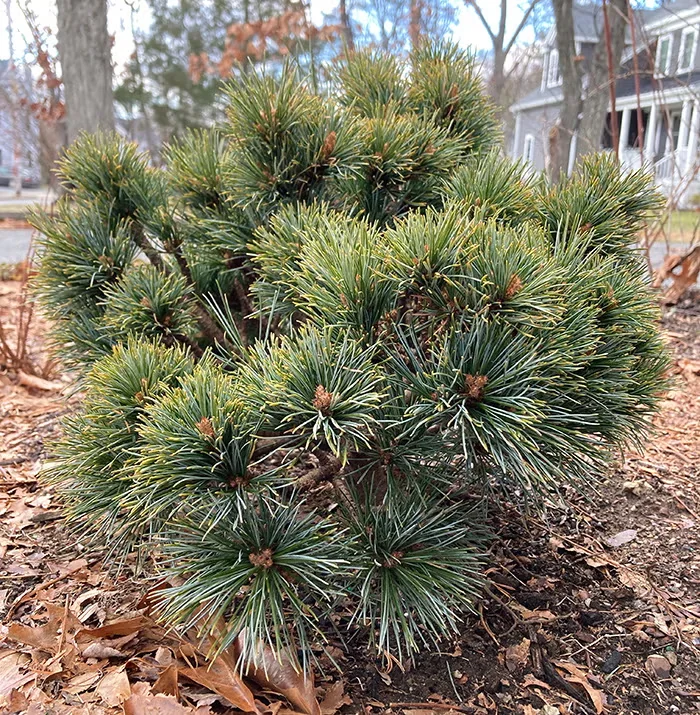
Common name: 'Blue Ball' Korean pine
Botanical name: Pinus koraiensis 'Blue Ball'
Foliage: The needles are absolutely the star of the show here. They're long and flexible, giving a fine texture that contrasts beautifully with the shrub's chunky shape and stiff branches. And that blue-green color? It leans decidedly more toward blue — really unique for a dwarf conifer.
Size and habit: This slow-growing dwarf conifer might stand just over a foot tall after 10 years. It has stiff, short, curving branches that form a charmingly irregular globe shape. It puts on about an inch of growth in every direction each year — so no rush here.
Origin: The species Pinus koraiensis is native to eastern Asia. The cultivar 'Blue Ball' was found growing as a witch's broom on a P. k. 'Silveray' at a German nursery back in the early 2000s, according to the American Conifer Society.
How to grow it: Give 'Blue Ball' Korean pine a spot in full sun and any well-draining soil. With its compact size, slow growth, and naturally appealing shape, there's no need for pruning or candling. Just make sure it gets consistent water while settling in — especially during its first fall. A good rule of thumb: evergreens should always be well-hydrated heading into winter. Once it's established, Korean pines are pretty drought tolerant. USDA Zones 3–8.
Related: Tempted to pair 'Blue Ball' Korean pine with hellebores? Find out if they're a good match, plus get some alternative ideas: "What to Plant With Hellebores."