“Most garden centers usually stock one or two sizes of any given perennial — typically quarts and gallons. Mail-order nurseries often give you size options at checkout too, including small plugs.…”
Paeonia minor
What's the Best Size Perennial Plant to Buy?
Most garden centers usually stock one or two sizes of any given perennial — typically quarts and gallons. Mail-order nurseries often give you size options at checkout too, including small plugs. Understanding the pros and cons of different pot sizes can really help you plan better and plant smarter.
Understanding perennial pot sizes
To make sense of all these sizes, it helps to know a little about how plants are produced. With perennials, young or bareroot plants get potted up into bigger and bigger containers until they reach that final "finished" size you see at the garden center. The starter plants come from wholesale growers who specialize in producing that young plant material. Then, further down the supply chain, "finished growers" take those starters and grow them into the larger sizes that end up at retail or on landscaping job sites.
In this article, we'll focus on the sizes you're most likely to encounter as a shopper — basically, what you actually see when you're out plant shopping. Those sizes fall into two categories: containerized plants and plugs.
At a garden center or any brick-and-mortar shop, perennials are usually in nursery pots. Plugs, on the other hand, are those starter plants I mentioned earlier — they used to be a wholesale-only product sold just to nursery pros. But these days, they're becoming way more available through retail and online sources.
Perennials for sale in pots
You've probably noticed that nursery pots come in all shapes and sizes. They're square, they're round, they're short and fat, tall and skinny — you name it.
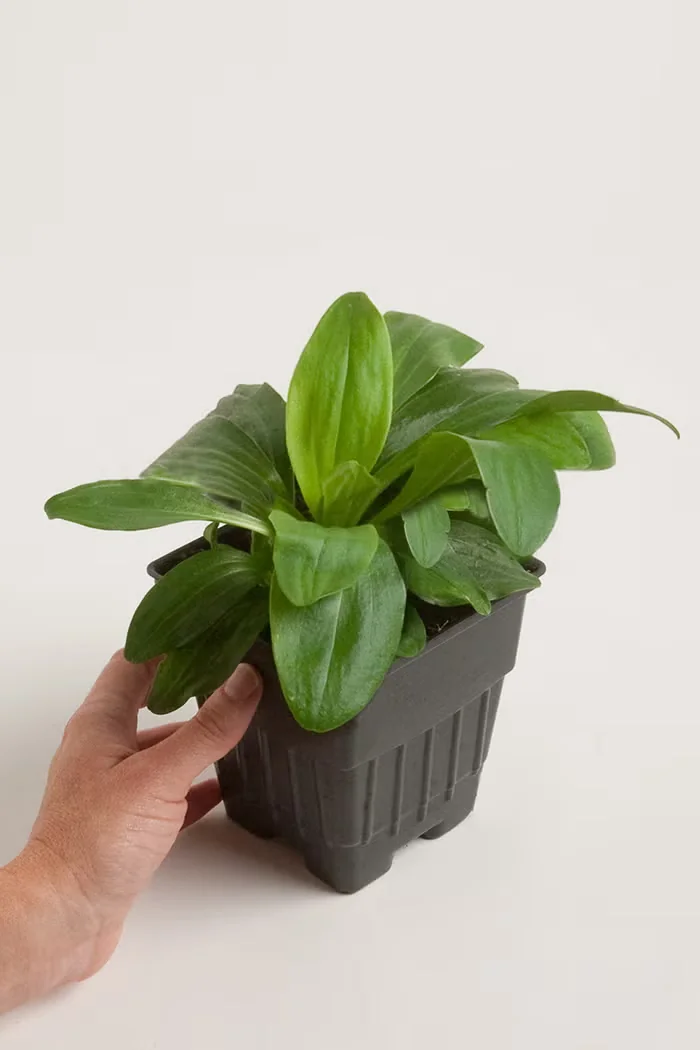
It might seem chaotic, but there are actually standards that group container sizes into classes based on volume. To keep things simple, we all use terms like "quart" and "gallon." These size classes cover a range, so the terms aren't exact volume measurements (a quart-sized nursery pot isn't necessarily 32 fluid ounces, for instance). But they're handy shorthand that everyone in the industry uses.
Quarts and gallons are what you'll see most often, and they're the ones that really matter for our discussion, so let's dig into those. (Less common are pints and other transitional sizes for starter plants and ground covers, plus two-gallon and larger containers that are mostly used for woody plants.)
A quart container is usually about four inches wide. These are used for perennials that stay smaller at maturity. With more soil volume than pints, they can handle perennials with bigger root systems. Quart-sized plants are ready to go straight into the ground — in other words, they're "landscape ready."
A gallon container is typically about six-and-a-half inches wide. This is hands down the most common size for perennials. The bigger soil volume works well for species grown from bareroot material, like Astilbe and Dicentra, and for anything with a larger root system. Gallon perennials are landscape ready too.
Pros & cons of perennials sold in pots
· Your best bet for instant gratification (especially if you're an impatient gardener like me).
· Bigger size means a bigger price tag, and the jump from quart to gallon can be pretty steep.
· But here's the thing — gallon perennials are often big enough to divide into several plants, which really brings down the cost per plant. Related: Dividing Perennial Plants: Why, When, How and What
· The bigger the pot, the bigger the hole you've got to dig — and the more soil you'll be disturbing.
· More soil volume helps buffer against stressful conditions. Smaller containers and plugs usually establish faster, but you'll need to keep a closer eye on them.
· Gallons have more developed root systems, but they're also more likely to be rootbound. If you find a rootbound gallon, your best move is to bareroot it — wash away the soil and gently tease out those roots — before planting.
· That said, always check the roots before you buy, especially in spring. A gallon that was just potted up that same spring might not have filled out the pot yet, so you could be paying mostly for potting soil with a tiny root system inside.
Perennials for sale as plugs
You'll notice plug availability the most in the native plant world, where ecological design and naturalistic planting styles call for planting thick and dense. Plugs make those projects way more affordable. Mail-order sources with a great range of native perennial plugs include Prairie Nursery and Izel Plants.
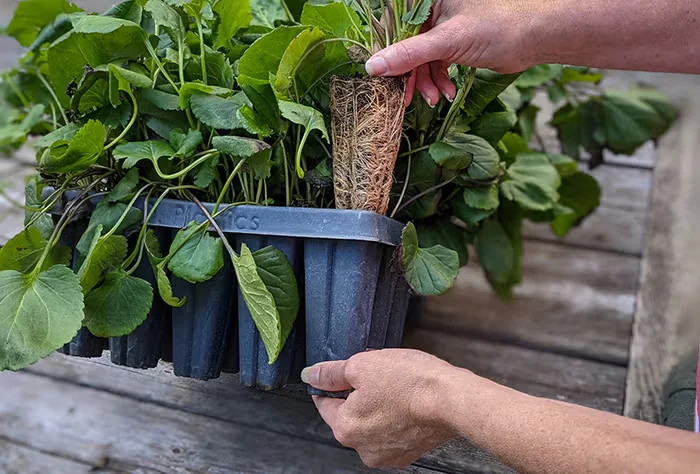
Plugs are young plants — usually under a year old — with surprisingly vigorous root systems. They're grown in plug trays, which are basically continuous sheets of individual little cells filled with potting soil, kind of like oversized seed-starting trays. The tray size is industry-standard at about 11 by 22 inches, and the plug size is usually described by how many cells fit in a tray: 72s, 50s, 32s, and so on. Bigger individual plugs mean fewer per tray, so 32s (32 plugs per tray) are noticeably larger than 50s (50 plugs per tray).
Just like containers, plugs come in different shapes and depths. Some are extra deep relative to their height, which makes room for a more robust root system. These "deeps" produce plants that are much better suited for going straight into the ground than shallower plugs. Small plugs like 72s can technically be direct-planted, but they're honestly a bit of a handful. Let's look at the sizes that are most likely to work as landscape-ready options.
The 50s are usually about two inches wide. These are the starter plants that finished growers typically pot up into gallons. Regular 50s can be a bit tricky to manage when planted straight in the ground, but deep 50s do much better.
The 32s are just a quarter inch wider than 50s. These are the starter plants destined for gallons and larger containers. They're landscape ready and a little easier to work with — and 32 deeps are even better.
Pros & cons of perennials sold as plugs
· The most budget-friendly option — perfect for big projects.
· Way easier to plant, especially in established gardens or tough soils. Small hole, minimal soil disturbance, and no need to bareroot or untangle roots.
· Plugs establish super fast. Why? Even though the plug cell limits their top growth, the plant keeps photosynthesizing and stores all that extra energy in the roots. When you free them from the tray, they're raring to go. Their surface-area-to-volume ratio is higher than bigger sizes, so they've got more energy to burn relative to their size. Most perennial plugs will catch up to a quart in a single season. Fast growers, especially grasses, can actually match a gallon in just one season.
· Plugs need consistent watering and attention, whether they're still in the tray or already in the ground. The small soil volume means there's less room for error when conditions get tough.
· It can be hard to tell tiny perennials from weeds — young plants often look pretty different from their mature, potted-up versions.
· Deer can yank them out of the ground way too easily.
· Plugs are almost never sold one at a time. You usually have to buy a whole tray of the same plant, though as demand has grown, some sources are starting to offer mixed trays.
Images courtesy of Izel Plants